Going wider
The use of Yashinon Auxiliary Wideangle lens

Recently, I gifted my Yashica 124G with a new pair of lenses. Oh, yeah, Yashica does not have interchangeable lenses, but their engineers smartly developed a series of additional lenses that are placed on top of the fixed camera lenses, capable of modifying the focal length. Basically, there are options to transform the lens into a macro, wide or telephoto lens.
Out of the three, I possess two - the macro and, most recently, the wide auxiliary lenses, which are the subject of this article.
As an interesting technical fact, the viewing auxiliary lenses are capable of correcting the parallax error with no extra accessories required, so there’s nothing left for the photographer but to look through, focus and shoot. Fairly convenient, thinking that Mamiya C series, for instance, if shooting closeups required a tripod mount of some sort to lift the camera to allow correct composition after focusing.
Also, using any of the auxiliary lenses on the Yashica makes the scale on the focusing knob unusable, hence looking through the viewfinder becomes essential. Worth saying at this point, focusing with the auxiliary lens attached is not the easiest. The viewing lens is quite soft, and most of the time, the use of the camera’s focusing loupe comes in handy.
At the same time, the taking lens’ size, makes the camera bulkier and heavier. Can still be used handheld, but I preferred a tripod as my left hand (which holds the camera when I shoot it) is a bit weak these days, and too much pressure on it hurts.


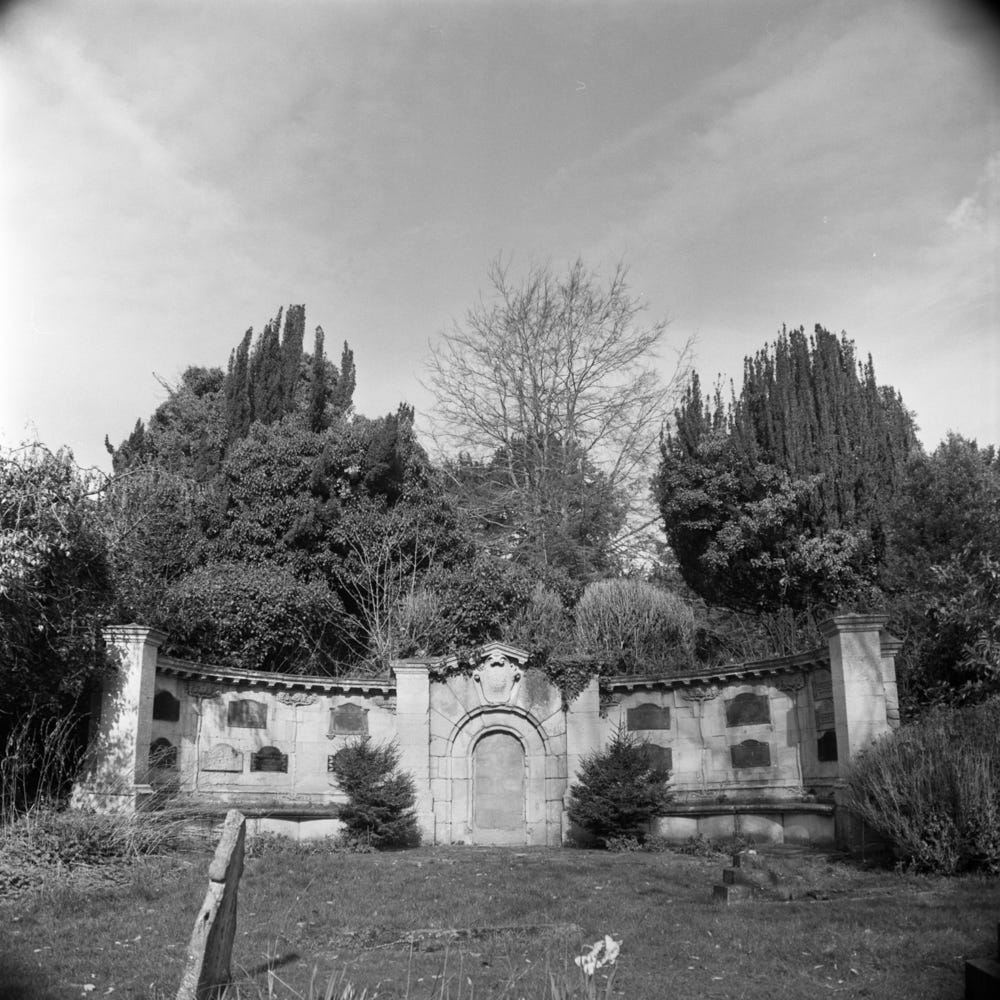
So, the Yashinon Aux Wideangle lens uses a standard Bay 1 mount (fits on other cameras besides Yashica-branded cameras) and can reduce the effective focal length of the camera lens by approx 25%, transforming my camera's 80mm lens into a 60mm, wider lens. As Yashica shoots 6x6 frames - medium format, in full frame talk, this translates into approx 50mm switched to 28mm. Quite a difference. Suddenly, confined spaces or larger landscapes are not a problem anymore, as the picture area is increased by approx 75%.


At a wide-open aperture (f/1:3.5 in this case), the lens is quite soft but creates a nice, dreamy image, which in some cases might be desirable.
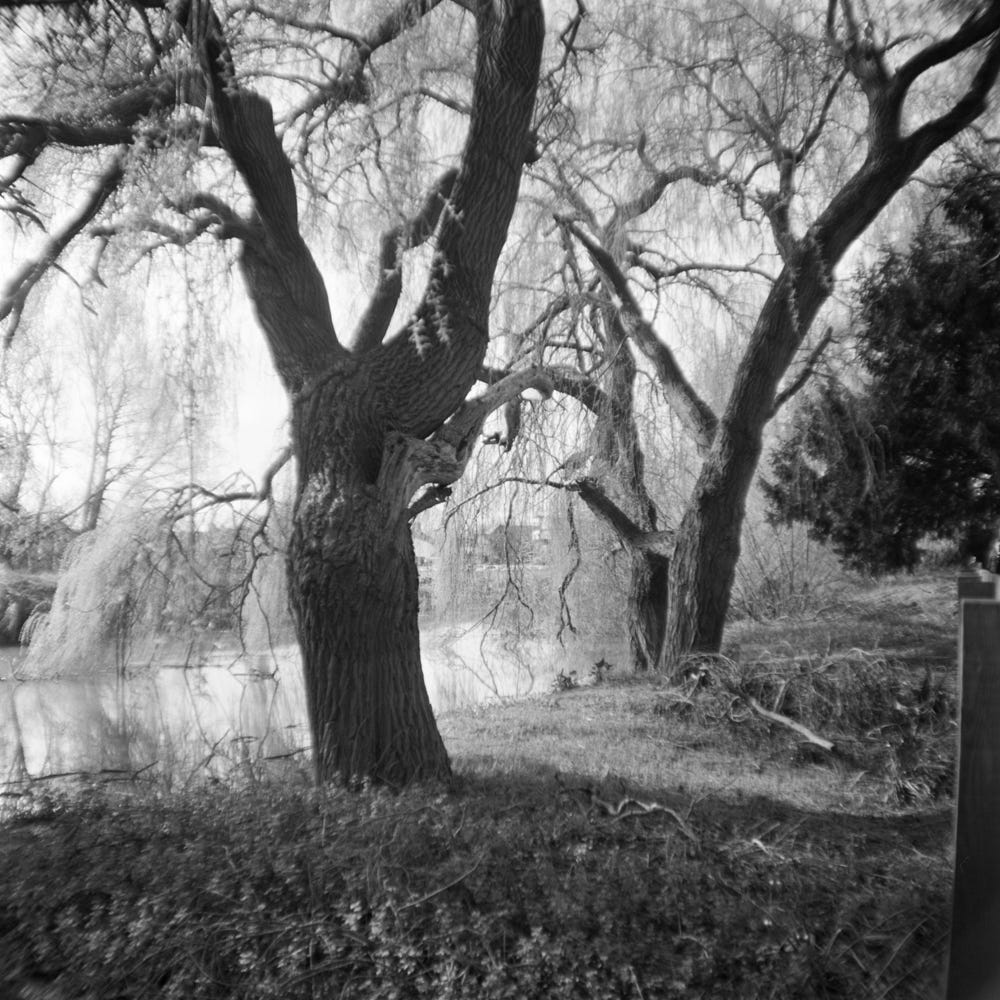
The Instructions leaflet states “the use of apertures from f/5.6 to f/11 is recommended. ‘Vignetting’ may occur at f/16 or f/22 apertures.” The vignetting does indeed occur.
Even more, in my case. The taking lens uses a 55mm thread mount to attach filters, but because my smallest filter is a 67mm, I needed to add step-up rings to make it fit. And that increased the vignetting considerably. Nonetheless, I like the outcome, and the images look quite vintage and charming.


I reckon they’ll print quite nicely, and the vignetting can be cropped if not wanted in the frame.
Until next roll(s),
John
for the heavy cameras (ie. bronica) i use a neck strap. that helps my left hand with the weight and eliminates the tripod
These are beautiful! The vignetting adds a special touch. - I wasn’t aware that a wide angle lens was an option. I have a Minolta Autocord with 2 close-up lenses but never even considered looking for a wide angle. I may have to be on the hunt!